Grower-shippers unconcerned about global warming report
Published on 07/27/2009
By Don Schrack
The Packer
"...By the end of this century, global warming could make California’s San Joaquin Valley no longer suitable for stone fruit, grapes and nuts, according to researchers at the University of California-Davis and the University of Washington, Seattle."
“The main message to the industry is that we must start developing long-term strategies to deal with this quite likely problem of the future,” said Eike Luedeling, a post doctoral researcher at UC-Davis.
Most vulnerable to the warming climate, Luedeling said, is winter temperatures. To achieve proper dormancy, most tree fruit, grapes and nuts require a minimum number of chill hours — when the temperature is between freezing and 45 degrees.
According to the study, weather data from 1950 to 2000 indicates chill hours are likely to decrease by more than 50% during this century.
Read rest of article
Tuesday, July 28, 2009

More Polar Bear Populations in Decline
More Polar Bear Populations in Decline - Dot Earth Blog - NYTimes.com:
"There is rising concern among polar bear biologists that the big recent summertime retreats of sea ice in the Arctic are already harming some populations of these seal-hunting predators. That was one conclusion of the Polar Bear Specialist Group, a network of bear experts who met last week in Copenhagen to review the latest data (and data gaps) on the 19 discrete populations of polar bears around the Arctic."
"The group, part of the International Union for Conservation of Nature, includes biologists in academia and government and at nonprofit conservation organizations. Only one bear population is increasing (in the Canadian high Arctic), while eight are declining in numbers, the scientists said. At its last meeting, in 2005, the group concluded that five populations were in decline. Three populations appear to be stable and seven are too poorly monitored to gauge a trend."
Read rest of post
"There is rising concern among polar bear biologists that the big recent summertime retreats of sea ice in the Arctic are already harming some populations of these seal-hunting predators. That was one conclusion of the Polar Bear Specialist Group, a network of bear experts who met last week in Copenhagen to review the latest data (and data gaps) on the 19 discrete populations of polar bears around the Arctic."
"The group, part of the International Union for Conservation of Nature, includes biologists in academia and government and at nonprofit conservation organizations. Only one bear population is increasing (in the Canadian high Arctic), while eight are declining in numbers, the scientists said. At its last meeting, in 2005, the group concluded that five populations were in decline. Three populations appear to be stable and seven are too poorly monitored to gauge a trend."
Read rest of post
Melting Permafrost Could Unleash Massive Carbon Dioxide Emissions
Climate Change Calculus: Why It's Even Worse Than We Feared
Published Jul 24, 2009
From the magazine issue dated Aug 3, 2009
Newsweek Voices - Sharon Begley
Newsweek.com
"Scientists have long known that permafrost, if it melted, would release carbon, exacerbating global warming, which would melt more permafrost, which would add more to global warming, on and on in a feedback loop. But estimates of how much carbon is locked into Arctic permafrost were, it turns out, woefully off."
" 'It's about three times as much as was thought, about 1.6 trillion metric tons, which has surprised a lot of people,' says Edward Schuur of the University of Florida. 'It means the potential for positive feedbacks is greatly increased.' "
"That 1.6 trillion tons is about twice the amount now in the atmosphere. And Schuur's measurements of how quickly CO2 can come out of permafrost, reported in May, were also a surprise: 1 billion to 2 billion tons per year. Cars and light trucks in the U.S. emit about 300 million tons per year."
Read rest of article
Published Jul 24, 2009
From the magazine issue dated Aug 3, 2009
Newsweek Voices - Sharon Begley
Newsweek.com
"Scientists have long known that permafrost, if it melted, would release carbon, exacerbating global warming, which would melt more permafrost, which would add more to global warming, on and on in a feedback loop. But estimates of how much carbon is locked into Arctic permafrost were, it turns out, woefully off."
" 'It's about three times as much as was thought, about 1.6 trillion metric tons, which has surprised a lot of people,' says Edward Schuur of the University of Florida. 'It means the potential for positive feedbacks is greatly increased.' "
"That 1.6 trillion tons is about twice the amount now in the atmosphere. And Schuur's measurements of how quickly CO2 can come out of permafrost, reported in May, were also a surprise: 1 billion to 2 billion tons per year. Cars and light trucks in the U.S. emit about 300 million tons per year."
Read rest of article
Politics-As-Usual While Planet Burns
Politics-As-Usual While Planet Burns: American Clean Energy and Security Act Can’t Solve Climate Crisis
By Brian Tokar
From the July 24, 2009 issue
of the Indypendent
"Carbon offsets have become the postmodern version of the indulgences the Catholic church used to sell in the Middle Ages to buy your way out of sin. But on a global scale, with corporations instead of individuals as the main players, they have become a scam of gigantic proportions."
"Rather than promoting innovative measures to reduce energy use in poor countries, as they are usually advertised, carbon offsets are subsidizing the already routine destruction of byproducts from China’s rising production of ozone-destroying hydrofluorocarbons, minor retooling of highly polluting pig iron smelters in India, and methane capture from a notoriously toxic landfill in South Africa."
Read rest of article
By Brian Tokar
From the July 24, 2009 issue
of the Indypendent
"Carbon offsets have become the postmodern version of the indulgences the Catholic church used to sell in the Middle Ages to buy your way out of sin. But on a global scale, with corporations instead of individuals as the main players, they have become a scam of gigantic proportions."
"Rather than promoting innovative measures to reduce energy use in poor countries, as they are usually advertised, carbon offsets are subsidizing the already routine destruction of byproducts from China’s rising production of ozone-destroying hydrofluorocarbons, minor retooling of highly polluting pig iron smelters in India, and methane capture from a notoriously toxic landfill in South Africa."
Read rest of article
Should bags get an 'eco-sin' tax?
Should bags get an 'eco-sin' tax? tallahassee.com Tallahassee Democrat:
BY WAYNE T. PRICE
FLORIDA TODAY
July 4, 2009
"Supporters say forcing consumers to pay anywhere from 5 cents to a quarter a bag would do wonders at curbing plastic bags' popularity their use and protecting the environment. Just as there are so-called sin taxes on alcohol and cigarettes, the plastic bag fee would be an 'eco-sin' tax, they say."
Read rest of article
BY WAYNE T. PRICE
FLORIDA TODAY
July 4, 2009
"Supporters say forcing consumers to pay anywhere from 5 cents to a quarter a bag would do wonders at curbing plastic bags' popularity their use and protecting the environment. Just as there are so-called sin taxes on alcohol and cigarettes, the plastic bag fee would be an 'eco-sin' tax, they say."
Read rest of article
Tuesday, December 2, 2008
Rev. Bear Endorses Uppsala Manifesto
Interfaith Leaders Sign Climate Change Manifesto of Hope
from Environmental News Service (ENS)UPPSALA, Sweden, November 30, 2008 (ENS) - Faith leaders concluded their two-day Interfaith Summit on Climate Change in Uppsala on Saturday by signing a manifesto demanding quick and extensive reduction of carbon dioxide emissions in the wealthy parts of the world.
Christian, Buddhist, Daoist, Sikh, Muslim, Jewish and Native American leaders signed the declaration that states, "We all share the responsibility of being conscious caretakers of our home, planet Earth. We have reflected on the concerns of scientists and political leaders regarding the alarming climate crisis. We share their concerns."
"The situation is critical," the manifesto states. "Glaciers and the permafrost are melting. Devastating drought and flooding strike people and ecosystems, especially in the South. Can planet Earth be healed? We are convinced that the answer is yes."
 |
Church of Sweden Archbishop Anders Wejryd addresses the Interfaith Summit on Climate Change. (Photo by Magnus Aronson courtesy Interfaith Summit) |
Hosted by the Church of Sweden, the interfaith leaders were welcomed with an opening address by Swedish Archbishop Anders Wejryd, who said, "We are not at this meeting to find special religious answers to the environmental crisis. We have to share the realities of technology, economy and politics with all people.
"We have gathered to deliberate on what we do with these facts as people of different religious traditions," said the archbishop. "As people of faith we are carriers of hope – or at least we should be. It is obvious that the world needs change before it is too late and we have a role to play in enabling a changed world-view and changed perspectives for people of the world and for ourselves."
The faith leaders held their summit and issued their manifesto on the eve of the United Nations' annual climate conference, held this year in Poznan, Poland from December 1 through 12. The Poznan meeting, which is expected to draw around 8,000 participants, is focused on advancing international cooperation on a future climate change agreement to govern the emission of climate-warming greenhouse gases after the Kyoto Protocol expires in 2012.
The future agreement is set to be finalized at the 2009 UN climate conference in Copenhagen, Denmark next December in time for countries to sign and ratify the document before 2012.
"As people from world religions, we urge governments and international organizations to prepare and agree upon a comprehensive climate strategy for the Copenhagen Agreement," the Uppsala Manifesto states. "This strategy must be ambitious enough to keep climate change below 2° Celsius (about 3.5 degrees Fahrenheit), and to distribute the burden in an equitable way in accordance with the principles of common but differentiated responsibility and respective capabilities."
Limiting warming to 2° Celsius above pre-industrial temperatures is essential to averting the worst effects of climate change, scientists say. Yet many environmentalists believe allowing the temperature to rise even that much would be disastrous. The global conservation organization WWF warns that a 2° Celsius temperature rise would bring droughts that will leave many people without safe, clean water, and destroy crops, causing widespread famine. Melting ice caps and glaciers would raise sea levels, leaving some Pacific island nations uninhabitable.
But the Uppsala Manifesto is entitled "Hope for the Future," and European Vice President Margot Wallstrom also took a hopeful view of the situation in her address to the Interfaith Summit on Friday.
"Combating climate change certainly makes sense. It makes sense because it is not only a challenge, but an opportunity. An opportunity to change the world and steer it towards sustainable development and prosperity for all," said Wallstrom.
By the year 2020, the European Union as a whole should cut its emissions by at least 20 percent compared to 1990 levels - and we will increase that figure to 30 percent if other developed countries make a similar commitment under a new international agreement, Wallstrom reminded the interfaith participants. The EU agreed to these targets in 2007 along with increased renewable energy sources and energy efficiency.
 |
Interfaith leaders bless the Uppsala Manifesto (Photo by Magnus Aronson courtesy Church of Sweden) |
"We are on track to get an agreement on the package in the coming weeks. If we can achieve this, we will be in a much stronger position to press for an ambitious agreement in Copenhagen next year," Wallstrom said.
But back in 2007, "no one foresaw the economic crisis that was about to engulf the world," the vice president said. "Faced with the present financial turmoil and economic recession, some EU governments - especially in Eastern Europe - have become unwilling to accept targets which they perceive as imposing further economic constraints on their industries. They question whether we can afford to take these drastic steps."
"My answer - to quote Barack Obama - is 'Yes we can!' In fact, we can't afford not to!" Wallstrom said.
She cited the 2006 report by UK economist Sir Nicholas Stern on the economics of climate change, which estimates that allowing climate change to continue unchecked would shrink the world's economic output by at least five percent and possibly as much as 20 percent per year if the most dramatic predictions come to pass.
"This dreadful prospect is exactly what a struggling global economy does NOT need," Wallstrom said. "By contrast, swift action to tackle climate change and to move to a low-carbon economy would cost only one percent of the world's Gross Domestic Product."
Hope for a climate agreement was strengthened when in Bali last December, the United States at last came on board. "This was a major breakthrough after years of resistance from the Bush administration," Wallstrom said, adding that President-elect Barack Obama "clearly has ambitions to combat climate change."
The Uppsala Manifesto calls for political leaders to reach an agreement during the preparations of the new global Climate Protocol 2009 on a strategy that is "sufficiently responsible and ambitious for the Earth to be saved for future generations."
But there are dissenting voices. Rajan Zed, a Hindu chaplain in northwestern Nevada and adjoining California, who delivered the historic first Hindu opening prayer in United States Senate in Washington, said today that the "grandiose" Interfaith Climate Manifesto signed at Uppsala lacks moral strength because of Hindus and other religions were not represented.
Other world religions, like Bahaism, Jainism, Shintoism, Confucianism, Zoroastrianism, and the Greek Orthodox Church also were not represented.
Zed, who is president of Universal Society of Hinduism, said that it was commendable to see diverse religious leaders, religions and denominations coming together to bless environmental causes in Uppsala, but the organizers should have given adequate and fair representation to all major world religions.
Zed said he admires the Church of Sweden and Archbishop Wejryd for taking the leadership role in organizing this "much-needed" summit and thus "making religions climate friendly."
The Uppsala Manifesto will create a new framework for discussion about climate change after the Kyoto agreement expires in 2012 said one of the signers, Professor Hava Tirosh-Samuelson, director of the Jewish Studies program at Arizona State University.
"Today it is widely acknowledged that world religions have an important role to play in revisioning a sustainable future, because religions are the repositories of values and norms that guide human actions toward the natural world," said Tirosh-Samuelson. "Through cosmological narratives, symbols, rituals, ethical directives, and institutional structures, religions shape how we act toward the environment."
"Hence," she said, "all attempts to transform our environmental attitudes so as to generate a sustainable world must include understanding of world religions and cooperation with religious people."
Copyright Environment News Service (ENS) 2008. All rights reserved.
Subscribe to:
Posts (Atom)
The Tree of Carbon Forgiveness

Penance -- Then and Now
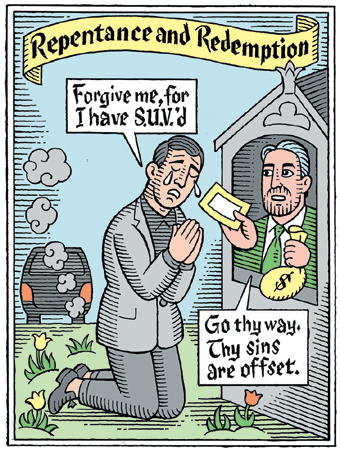
In the Middle Ages, there was no buying and selling of carbon indulgences. Now it's a booming business. "The worst of the carbon-offset programs resemble the Catholic Church's sale of indulgences back before the Reformation," said Denis Hayes, the president of the Bullitt Foundation, an environmental grant-making group. "Instead of reducing their carbon footprints, people take private jets and stretch limos, and then think they can buy an indulgence to forgive their sins." The New York Times, 4/29/07

What's a Carbon Footprint?